Transparency Grade: D-
Health Connect Registry
What's the data showing?
Primary care is the foundation of our healthcare system. With over a million people without a family doctor, there is very limited data on exact numbers or geographic distrubution.
The Health Connect Registry is effectively a waiting list to be attached to primary care. When people are placed on the list, they have no idea how long it will be until they're attached. Data on the size of the list and time spent on list, broken down geographically, is expected.
Limited reliable data available
This is an area where government has deliberately misrepresented information, both during the 2024 election campaign and previously. A few notable examples follow.
We often hear statistics about the number of people "connected to a family doctor or nurse practitioner," e.g. 248,000 people from Jul/2023–Oct/2024. Presumably this is the number of people pulled off the Health Connect Registry. Not mentioned is how many people were disconnected from a family doctor or NP during that time. People always lose doctors... they move, change jobs, retire, etc. Churn is normal. And what about patients who attend a meet-and-greet with a doctor who doesn't accept them into their practice? There is no mention of net attachment. In other words, are we further ahead, or not?
"We will make sure everyone who wants a family doctor or nurse practitioner gets one by the end of 2025" - based on a hypothetical extrapolation of data saying they expect to match another 160,000 in the next six months (after the election). Not grounded in reality. And not even in mathematics. Even if you were to believe that 160,000 in six months (from Oct/2024), that would still match 360,000 people (again, forget about those losing their doctors). But with > 1M without one…?
"88% of people in BC have a family doctor" was a whopper that came out in the election campaign. Where did this come from? Not the BC government's actual data. An "election priorities" document from Doctors of BC contained the line "more than 700,000 patients are still without a family doctor in BC." So that's 12.7% of BC's population, so... 88% have a doctor. Except that the 700,000 number was equally pulled from the air because no data was available. They chose a deliberately conservative number that they could defend. It's not saying the real number isn't a LOT more than 700k.
There's a lot of cherry-picked data and blatant misrepresentations of unreliable estimates being released for propaganda purposes, but little real data is published, though it is available internally.
Experimental visualization
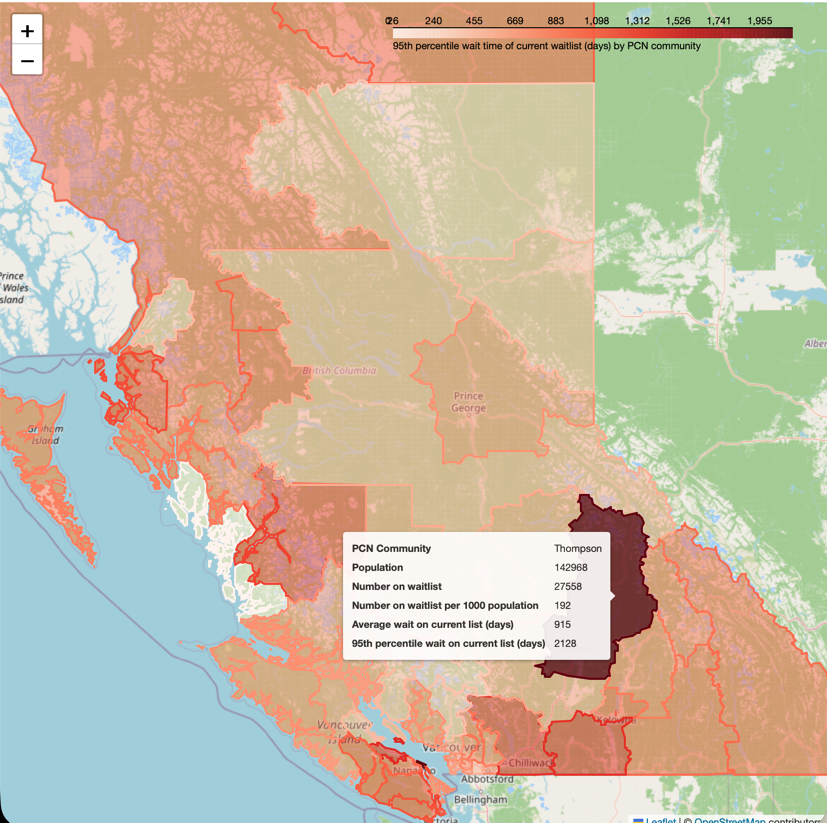
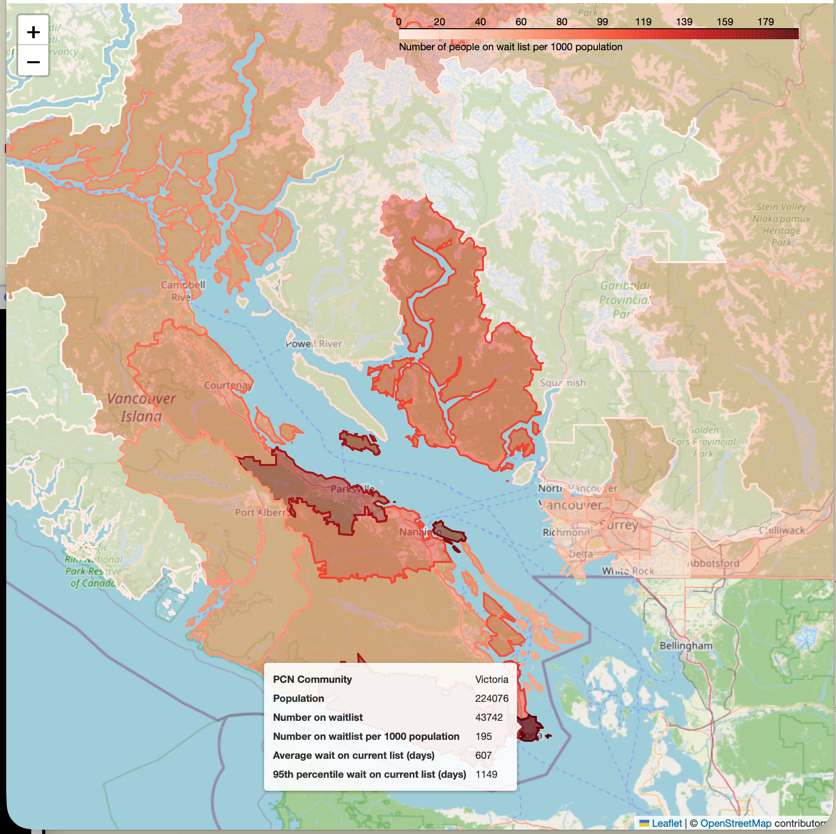
Health Connect Registry data by PCN community.
Left highlights 95th percentile number of days waiting on current list. Right highlights number of people on list per 1000 population. Click to open in new window. Pan/zoom interactive maps and hover for tooltip showing data on the community. Based on Jul/2025 HCR data from FOI as described on this page.
Registry wait times
The data below provides wait time statistics for people still on the HCR… in other words, how long they've been waiting to be attached to primary care, but still hadn't been. Average times run from a few months to ~2.5 years, while 95th percentile (i.e., closer to the longest on the list) run to > 5 years. Where you live matters.

Attachment and population stats
The chart below was derived from a FOI request that did provide statistics on the number of people on the HCR at a variety of time (Jul/2023–Jul/2025), broken down by primary care network across the province. As of Jul/2025, some PCNs had essentially nobody waiting on the list; the highest has > 43,000 people waiting.
The chart aggregates these by health authority. Number on the list per 1000 population:
- Island Health: 133
- Interior Health: 88
- Northern Health: 58
- Fraser Health: 49
- Vancouver Coastal Health: 41
However, as another FOI notes, that doesn't tell the complete story. A FOI for Westshore gave a good snapshot for May/2025. At the time, over 30% of Westshore residents are not attached to primary care.
68% are attached.
Of the rest, 17% are on the govt's HCR (Health Connect Registry, i.e., waiting list). 18% are not on that waiting list for whatever reason.
24% of those on HCR are currently attached to another provider—presumably that's not working out so well, whether because they've moved, are dissatisfied with access/service, etc.
The latter stat reinforces that just being nominally "attached" to primary care is very different from having usable access to needed primary care services.


What's missing?
Any reliable and representative sources of data about access to primary care.
How does primary care attachment compare with...?
Assume BC has at least 20% of people not attached to a family doctor. Likely far more than 20%.
Denmark. 98% have a family doctor.
Netherlands. 96% have a family doctor.
Sources
Health Connect Registry Metrics - by PCN Aug/2022–Jul/2025 [source: FOI]
Health Connect Registry Metrics - by PCN Aug/2023–Nov/2024 [source: FOI]
Health Connect Registry and Population Metrics - Westshore Communities [source: FOI]
Health Connect Registry Metrics - Oceanside/Nanaimo/Cowichan 2024 [source: FOI]
Health Connect Registry Metrics - by PCN 2022 [source: FOI]